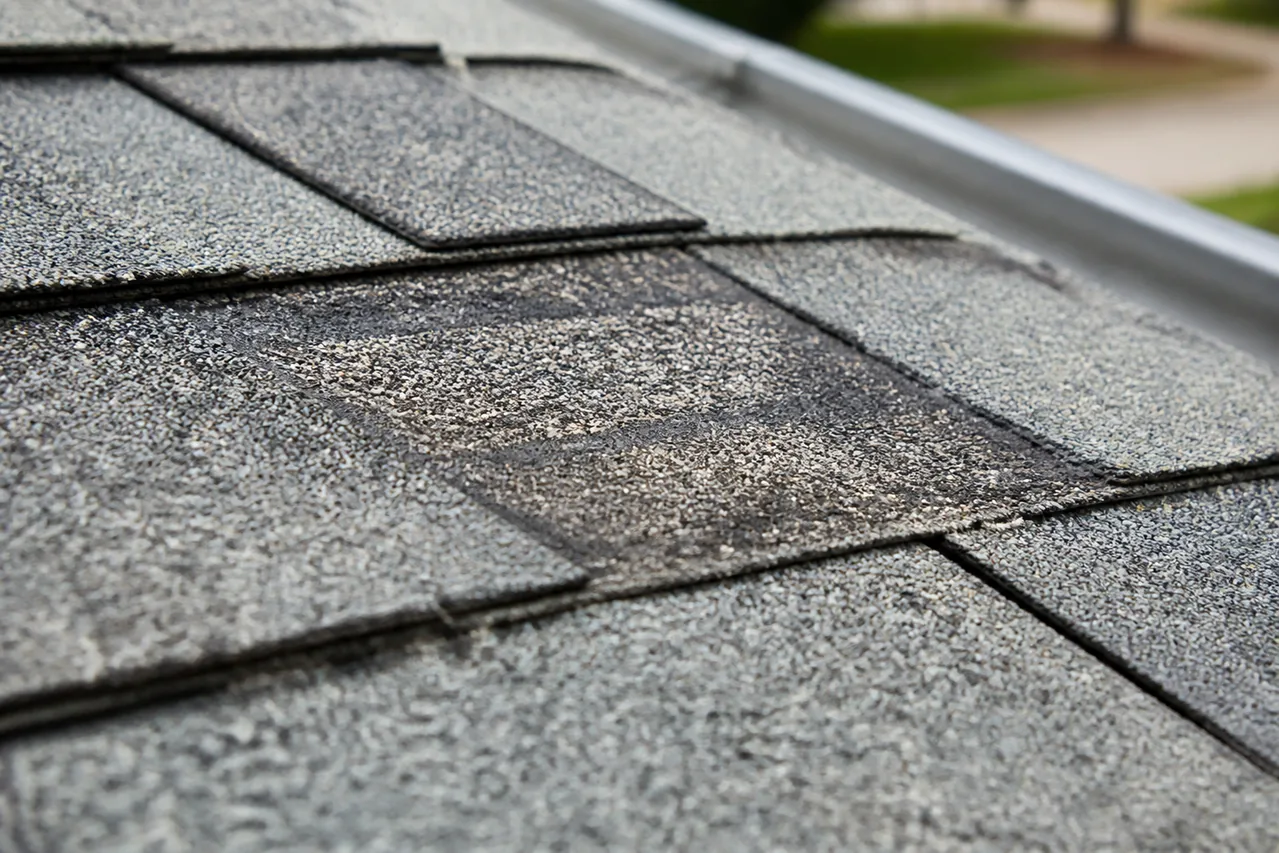
Why granules matter
Mineral granules form part of the asphalt-shingle surface. Their distribution and condition contribute to weathering performance and appearance, but some movement does not automatically establish roof failure.
Context changes the meaning
Amount, location, concentration, roof age, recent weather, prior work, and shingle-surface condition matter. A close-up of granules in a gutter cannot show where they came from or how broadly the roof is affected.
Useful observations
Note bare-looking areas, differences between roof planes, new accumulation after a storm, and visible impacts or missing shingles. Keep dated photos and avoid climbing onto the roof.
Choose the route after inspection
Granule loss alone does not prove storm damage, rejuvenation suitability, or the need for replacement. Professional inspection should distinguish monitoring, repair, preservation evaluation, and replacement concerns.
Gutter granules are only one piece of evidence
Granules found during cleaning may come from different roof planes and time periods, and a photograph of the pile does not show the condition of the asphalt surface beneath it. New construction debris, recent foot traffic, repairs, drainage concentration, and severe weather can complicate the observation. Compare changes over time rather than estimating severity from one collection. A professional review may examine whether loss is uniform or concentrated, whether exposed-looking areas are present, and whether cracking, edge movement, impact concerns, leakage, or missing materials accompany the granule change.
What to ask after an inspection
Ask where the granule change is occurring, how widespread it appears, and which related roof details were reviewed. Ask whether the recommendation is monitoring, repair, preservation evaluation, storm-focused assessment, or replacement planning, and what evidence supports that route. If treatment is discussed, ask how remaining surface condition and product compatibility affect suitability; a treatment cannot replace missing granules or reverse every form of deterioration. Retain photographs from identified roof planes so later reviews can compare the same locations. Avoid any contractor who declares storm damage, treatment eligibility, or replacement need from a gutter photo alone.
Decision takeaway
The responsible conclusion is rarely “granules equal one specific outcome.” Their source, distribution, timing, and related roof conditions matter. Document what you can safely see, preserve pre- and post-event records, and ask for a roof-plane-specific assessment. Rejuvenation, repair, storm evaluation, monitoring, and replacement are distinct routes with different evidence needs. No photograph or amount collected at a downspout can by itself confirm eligibility, cause, or remaining roof life.